


Season of Easter (Easter Day 31 March) including Ascension (9 May) and Pentecost (or Whit Sunday 19 May)
The Great Fifty Days of Eastertide form a single festival period in which the tone of joy created at the Easter Vigil is sustained through the following seven weeks, and the Church celebrates the gloriously risen Christ:
Triumphant in his glory now,
his sceptre ruleth all,
earth, heaven and hell before him bow,
and at his footstool fall.
(Fulbert of Chartres)
The Easter or Paschal Candle stands prominently in church for all the Eastertide services. The Alleluia appears frequently in liturgical speech and song. Morning Prayer begins with the traditional collection of Pauline texts known as the Easter Anthems, and white or gold vestments and decorations emphasize the joy and brightness of the season.
On the fortieth day there has from the late fourth century been a particular celebration of Christ’s ascension. He commissions his disciples to continue his work, he promises the gift of the Holy Spirit, and then he is no longer among them in the flesh. The ascension is therefore closely connected with the theme of mission. The arrival of the promised gift of the Holy Spirit on the day of Pentecost completes and crowns the Easter Festival, ten days later, on the fiftieth day of Easter.
From Common Worship
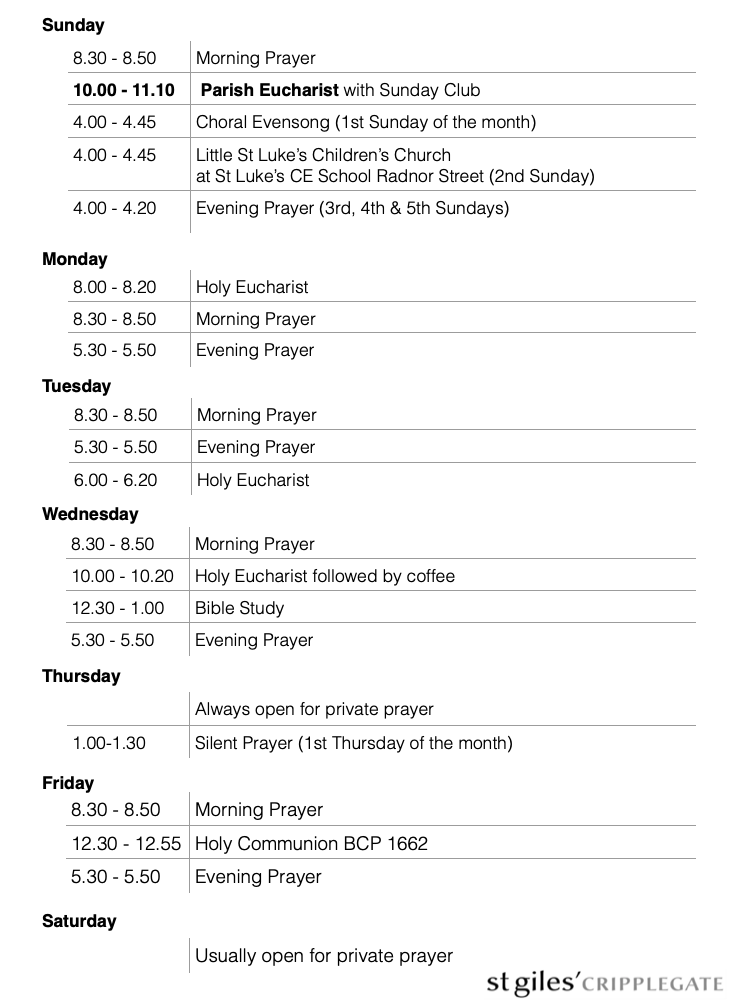





Sunday
8.30- 8.50 Morning Prayer
10.00-11.10 Parish Eucharist with Children's Sunday Club
4.00-4.45 Choral Evensong on 1st Sunday of the month.
4.00-4.45 Little St Luke's Church at St Luke's CofE Primary School on 2nd Sunday of the month
4.00-4.20 Evening Prayer
on 2nd, 3rd, 4th and 5th Sundays in the month.
Monday
8.30 - 8.50 Morning Prayer
5.30 - 5.50 Evening Prayer
6.00 - 6.20 Holy Eucharist
Wednesday
24 April
Lectio Divina on Zoom at 7.30pm.
Please contact Susan Royce for details susanjroyce@gmail.com
2024 Dates for Silent Prayer from 1-1.30 pm and Cleaning Angels from 1.30-3pm with tea and cake, on first Thursday of the month.
You are invited to join others in church on the first Thursday of the month.
If you are not able to join us, we hope you will continue to pray with us wherever you are.
- 2 May,
- 6 June,
- 4 July
- not in August
- 5 September
- 3 October
- 7 November
- 5 December.
2024 Dates for Standing Committee Meetings - held in the Rectory at 6.15pm
- 3rd June
- 1st July
- 16th September
- 4th November
2024 Dates for PCC Meetings
(please note the themes for each meeting in Dark Blue) held in the church at 7.30pm but in the Rectory when with Supper
- 12th May (APCM + PCC)
- 20th May (Supper) ‘Mission’
- 3rd July
- 7th October ‘Safeguarding’
Parish Office Hours
For the Parish Administrator
Tuesday, Wednesday and Friday 10am-4pm
Phone 07535 442955 or
For the Bookings and Events Co-ordinator, Buildings Supervisor
Phone 07766 202731 or
Safeguarding is at the heart of our
Christian faith. We are all made unique and in the image of God.
‘Jesus came that we might have life and have it in abundance’ John 10 v 10.
St Giles’ works to ensure a safe environment for everyone. Please click the ‘safeguarding' tab on this website for more information.
 Share
Share Print
Print 