
This history is based on a booklet prepared by The Revd
Edward Rogers for the
inauguration of the Grand organ in 1970.
Organs have been in use in churches since the tenth
century, but it is not known
when St Giles Cripplegate was fi rst furnished with one. The records show
that
Thomas Morley served the church as organist for a number of years in the
sixteenth century before his appointment as organist of St Paul’s Cathedral,
but details are incomplete. Records were not properly kept at this date and,
surprisingly, the fi rst recorded evidence of the use of an organ in the
church is
not found until the Minutes for 1672, now deposited in the Guildhall
Reference
Library. In this and later years there are many entries of interest in the
Vestry
Minute Books concerning the organ and the organists. This first Minute of
1672 reads as follows:
“that Mrs Charnock shall have thanks given her for her
affection in bestowing
a fair organ on the Parish Church of St Giles Without Cripplegate, London.
That a convenient place be found for the setting of it up, and that the
Vicar and Vestry find out some way and means for the maintenance of the
Organist”.
The last part of the Minute implies that there was no
organ in the church at that
time nor organist appointed; and implies the strong probability that the
Puritans,
in their great zeal for simplicity in worship, had removed all instruments
of
music from the church.
John Milton may have played the organ in St. Giles. Milton, England’s
greatest
epic poet, who worshipped regularly in the church up to 1674, has written of
the
church organ as “rolling waves of sound on roof and floor”. His ‘Il
Penseroso’
contains the lines:
“There let the pealing organ blow
In the full-voiced choir below
In service high and anthems clear.
As may with sweetness, through mine ear,
Dissolve me into ecstasies
And bring all heaven before mine eyes”
Milton’s father was well known as a musician and
composer and John Milton
himself was no indifferent performer on the organ; and was the friend of
many eminent organists of his day including the aged Monteverdi. Milton met
Claudio
Monteverdi, then organist of St Mark’s and a member of the choir, when on a
visit to Venice in May 1639. An organ in Vallombrosa used to be shown as one
on which Milton actually played during this tour.
John Milton’s nephew, Edward Phillips, who lived with him in Aldersgate
Street
and was tutored by him for a time from the autumn of 1640, stated that the
household had a studious routine. The daily rest period was for an hour or
so
before lunch. During this period Milton frequently played the organ or some
other instrument. This custom was still continued twenty years later when
Milton lived in Jewin Street, near Redcross Street.
There is a pleasant tradition, unsupported by evidence, that Milton played
the
organ at Hampton Court during the years 1649-1652, which organ has since
been removed to Tewkesbury Abbey. It is of course possible that he played
this, and an organ in St Giles. When in 1660 onwards blindness and age kept
him to his house in Jewin Street he played the organ more frequently.
A minute in St Giles Church Vestry Book dated 6th August 1673, records:
“that the Churchwardens do take sufficient care forthwith that the floor of
the gallery whereon the Organ standeth be well and sufficiently amended,
and that there be pallasados set up, and the charge thereof be allowed to
them in their accounts”.
In 1688, the organ was repaired and cleaned by Father Smith, the famous
organ builder, at a cost of twelve pounds.
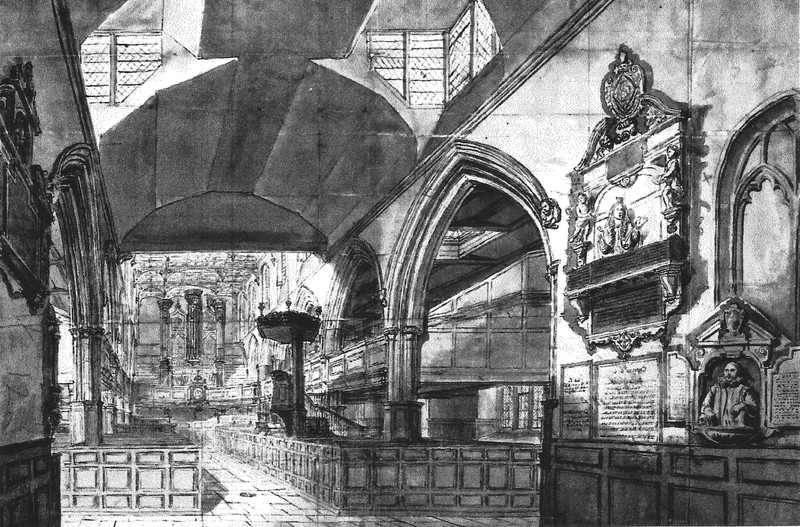
In 1704 many alterations and additions were made in the church, amongst
these being the erection of a large singers and organ gallery at the west
end of
the church, on which was placed a new organ, the old organ being removed
from the church.
The fine new three manual organ of 1704 was the work of Renatus Harris, and
cost four hundred pounds. The Parish retained the services of the celebrated
Dr John Blow, one of the masters of Henry Purcell and organist of the Chapel
Royal and Westminster Abbey, to advise them on the building progress. Dr
Blow
was extremely satisfied with the result. Indeed such admiration,
appreciation
and interest was aroused that clergy and organists came from far and near to
hear it played. When Renatus Harris was commissioned to build the organ for
St Dionis Backchurch, it was stipulated in his agreement that the organ
should
look and sound like the new organ in St Giles Church, Cripplegate. Harris’s
organ had an elaborately carved oak case ornamented with well designed gilt
cherubs. It was cleaned and maintained by Mr Harris until 1709, in December
of which year the Vestry appointed Mr Abraham Jordan to look after the
organ.
In 1726 the organ front was regilded at a cost of £21, and over the
following
years there was some renewal of movements and voicing, as well as minor
repairs and re-cleaning.
By 1734 the care of the organ had passed to Mr Bridge
and, at a cost of £170,
he effected a number of small repairs and added several stops. Various
repairs were made during the following years, but nothing of importance was
done until 1840, when Messrs Gray and Davison put the organ in thorough
order at a cost of £250. This was in fact a rebuild of the Renatus Harris
organ
of 1704, retaining all the original materials and the additions of 135
years, and resulting in a much superior instrument.
The large organ and singers gallery, built in 1704, was dismantled in 1864,
and
the organ moved to the foot of the tower. This new position was not
satisfactory,
and in 1878 the organ was further moved from the fl oor at the west end of
the
church to a more appropriate position at the east end of the north aisle,
where
the new Chancel organ stands today
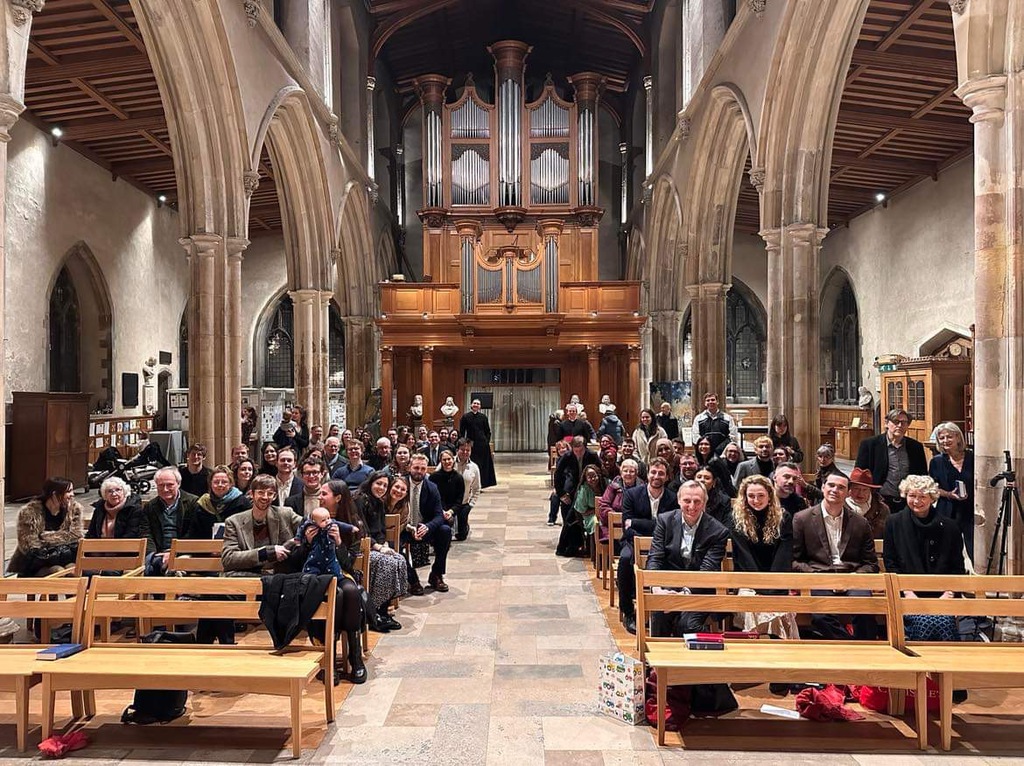
The Grand (west) organ
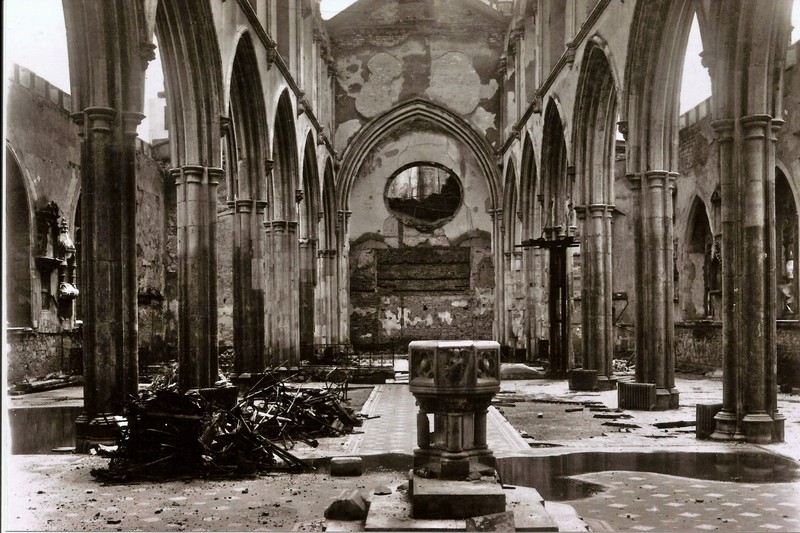
After the war when restoration work got under way at St
Giles the first thoughts
were to consult Messrs J W Walker and Sons about a new organ similar in size
and performance to that destroyed. Then the situation suddenly changed. In
December 1959 St Luke’s Church, Old Street was declared dangerous, due to
the subsidence of the foundations. Noel Mander immediately, and at personal
risk, dismantled St. Luke’s magnificent organ of 1733 and brought it to the
south aisle of St Giles Church for storage. When the two parishes were
united
the organ became the property of St Giles Church and it was agreed that it
should be rebuilt here by N P Mander Ltd. The St Luke’s organ was
built by Jordan and Bridge in 1733 and was presented to St Luke’s by a
Mr Buckley of Old Street. The organ contained 22 stops over
3 manuals. Its case was almost identical with that of the St Giles Harris
organ
of 1704, and it is most likely that it was made by the same cabinet-maker,
or
one of his pupils.
Henry Smart composer of many popular hymns, organ pieces and anthems,
was appointed organist of St. Luke’s in 1844. He left in 1865, by which time
he was totally blind, and moved to be organist of St Pancras Church. Under
Smart’s direction in 1844 Messrs Gray and Davison, who were also then
maintaining the St. Giles organ, carried out a great deal of work. This 1844
rebuild resulted in Great 14 stops, Swell 9, Choir 7, Pedal 2, couplers 6In
1862 Messrs Gray and Davison added a Pedal Reed and one year later
‘Father’ Willis rebuilt the whole organ; John Stainer (later Sir John
Stainer), then
organist of St Paul’s Cathedral, was consultant in this rebuild, which
reduced
the Great by two stops. ‘Father’ Willis undertook further repairs and
cleaning in 1883 under the guidance of C W Pearce, who was organist from
1874 to 1885. Mr Pearce was advised in this work by Sir John Stainer.
In 1902 Henry Jones of Fulham added two entirely new stops to the pedals, a
Trombone Reed and a Pedal Bourdon.
The organ suffered some slight damage in 1940 when incendiary bombs
fell on
the roof of St Luke’s; minor repairs were speedily effected. In 1947 Messrs
N P
Mander overhauled and thoroughly cleaned the instrument, and installed a new
blowing plant and motor. The church was unable to raise the necessary
finance
for other recommended improvements (a new console, addition of string tone
and work on the action). Nevertheless, the fine tone of the organ was such
that a number of recitals were broadcast on the BBC Third programme in the
immediate post-war years.
Now, following the Organ Appeal, there are three organs in
St Giles in regular use.
Specifications
Chancel Organ (Mander Organs 2008)
Great Organ (6 stops)
1. Open Diapason
8
2. Stopped Diapason 8
3. Principal
4
4. Fifteenth
2
5. Mixture IV
11/3
6. Trumpet
8
Swell to
Great
Swell Organ (6 stops)
7. Gedackt 8
8. Principal 4
9. Chimney flute
4
10.
Recorder
2
11.
Sesquialtera II
22/3
12.
Oboe
8
Tremulant
|
 |
 |
Pedal Organ ( 3
stops)
13. Bourdon
16
14.
Principal 8
15.
Trumpet
8
Great to Pedal
Swell to Pedal
Compass
Key compass
C to a3 (58 notes)
Pedal compass C to
f1 (30 notes) Straight Concave
Practice Organ (situated in the
vestry, with its own entrance from the churchyard)
(Tickell 2009)
MANUAL 1
Stopped
Diapason 8
Principal
4
MANUAL 11
Chimney Flute
8
Spitz Flute 4
PEDAL
Open Flute
8
Manual 1 to Pedal Coupler
GRAND ORGAN
Organ by Jordan and Bridge 1733, Fr. Willis
1863, N.P. Mander Ltd. 1941,1970,1991
Swell (enclosed)
Open Diapason 8
Viola 8
Stopt Diapason 8
Principal 4
Fifteenth 2
Mixture lll
Contra hautboy 16
Cornopean 8
Clarion 4
Tremulant
Pedal
Open Diapason 16
Bourdon 16
Octave 8
Gemshorn 4
Mixture lll
Trombone 16
Trumpet 8
Great to Pedal
Swell to Pedal
Choir to Pedal
Cymbelstern
|
 |
| |
|
Great
Double Open Diapason 16
Open Diapason 8
Stopt Diapason 8
Principal 4
Flute 4
Twelfth 2 2/3
Fifteenth 2
Larigot 1 1/3
Mixture lll
Fourniture lV-Vl
Mounted Cornet V*
Trumpet 8*
Clarion 4*
Great Reeds on Choir
Swell to Great
Choir to Great
Choir
Stopt Diapason 8
Dulciana 8
Principal 4
Nason Flute 4
Nazard 2 2/3
Spitz Flute 2
Tierce 1 3/5
Cymbel lll
Cremona
8
Mounted Cornet V* (from Great)
Tremulant
5 department pistons to Swell, Great, Choir.
Independent sequencer.